
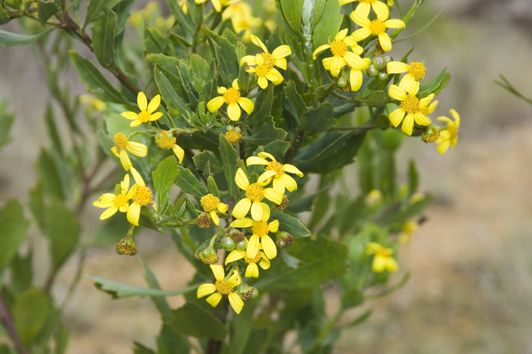
Boneseed (Chrysanthemoides monilifera ssp. monilifera) is a large perennial shrub and an environmental weed that has the potential to threaten natural ecosystems and spread throughout the south-west and surrounding areas if allowed to establish.
Boneseed is a declared pest in Western Australia and must be reported to DPIRD if found.
Landholders are obligated under the Biosecurity and Agriculture Management Act to report any boneseed finds on their properties and undertake relevant controls and to continue regular monitoring until it has been extirpated or eradicated.
By reporting suspected boneseed, landholders and other observers are contributing to a wider effort to assist with eradication of the pest from WA.
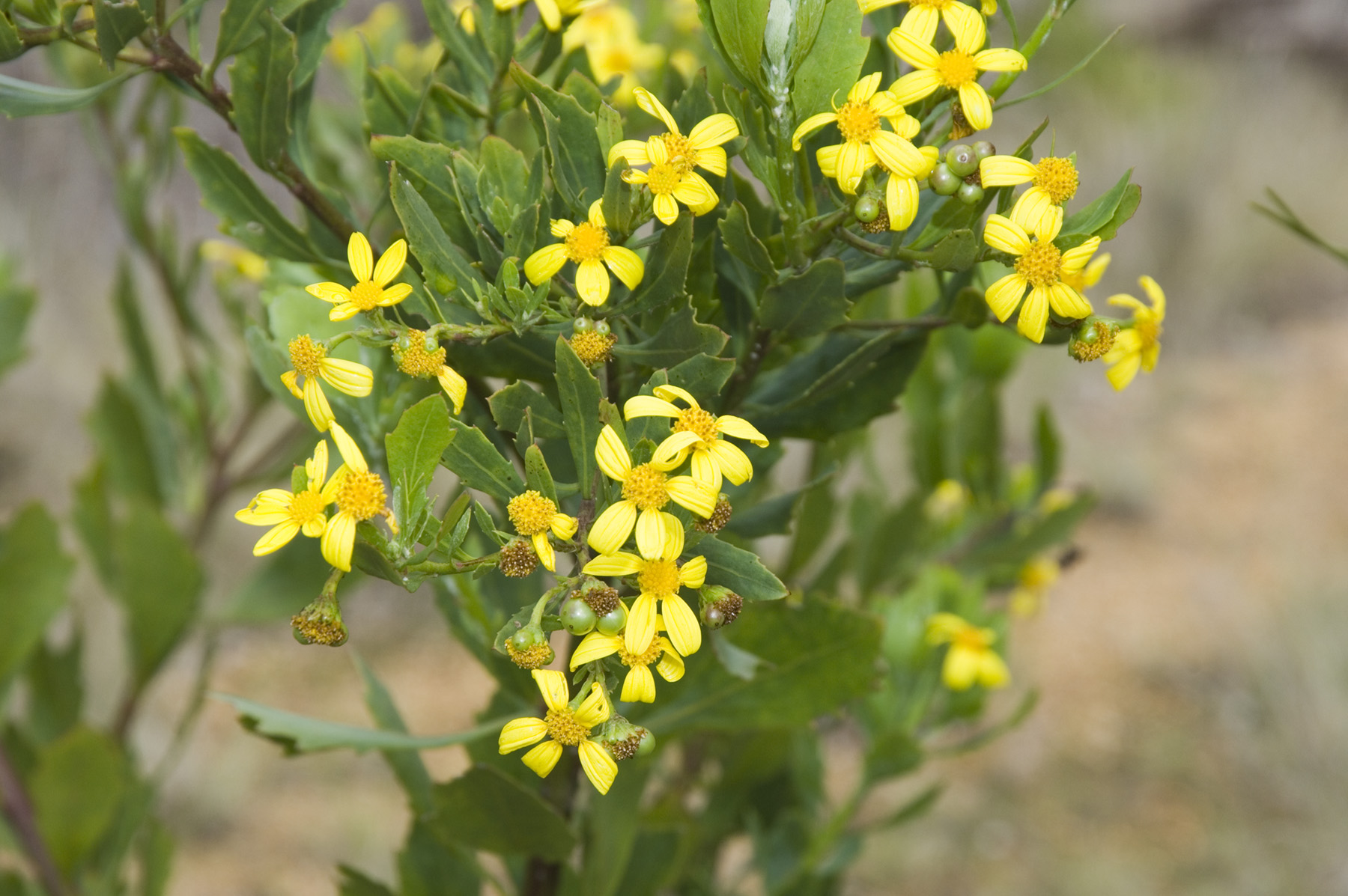
What to look for
- large perennial evergreen shrub up to 3 metres high, erect and densely branched
- bright yellow flower clusters
- dull green, smooth, irregularly serrated and paddle-shaped leaves
Find out more about identifying boneseed
Key points
- If found, report it with the MyPestGuide Reporter app or online tool.
- Seedlings are shallow-rooted and easily hand-pulled, mature plants can be dug up.
- Collect and bag-up any fruit or seeds (on plant or ground) for disposal.
- Movement is prohibited. Leave weeded plants to die where found to prevent spread.
More information
In Western Australia boneseed has the potential to endanger threatened plants and ecological communities throughout the south-west and surrounding regions. It invades native bushland and forms dense thickets that smother native plants and prevent regeneration.
Introduced to Australia as a garden plant in the late 1800’s, it is fast growing, aggressive with no natural enemies and spreads easily from gardens to the environment and has allelopathic effects on other vegetation.
It reproduces by seeds that are spread into bushland by birds, rabbits, foxes, emus and other animals (only seedlings are palatable). Seeds can also spread via dumped garden waste, and on vehicles and equipment. Plants can produce enormous amounts of seed (up to 50,000 seeds per plant every year!) that germinate readily. Shrubs can live for 10 to 20 years.
Several infestations in the Perth Hills, the south west and in wheatbelt towns are under surveillance working towards eradication.
Boneseed:
- invades forests, woodlands, shrublands, dunes, coastal areas, heathlands, riparian areas, sclerophyll forest and mallee – both disturbed and undisturbed, including roadsides, gardens and bushland
- grows in most soil types and tolerates a wide range of climates, but does not tolerate water-logged soils
- rapidly colonises after disturbance such as clearing or burning
- fire will kill plants but will also stimulate seeds and the seedbank
- alters habitat and displaces food plants of native birds and animals
- replaces native nectar plants important to beekeepers, and can restrict access to beaches, parks, and trails.
- very hardy and adaptable with vigorous growth and can outcompete native vegetation by altering soil properties.
Boneseed is an erect, perennial, shallow-rooted evergreen shrub that grows up to 3 metres tall and is spread by seed with bright yellow flowers making it easy to identify in spring.
Juvenile plants can be confused with the native boobialla (Myoporum insulare) which is a coastal shrub found in all southern states, including WA. Boobialla seedlings do not have the white downy hair, and plants have white flowers.
It is closely related to Bitou bush (Chrysanthemoides monilifera ssp rotundata), a sprawling plant, which is now considered eradicated in WA. Boneseed is more erect, among other differing features including less petals and round seeds (not oval).
It can also be confused with native buttercups (Hibbertia sp.), African Veldt daisy (Osteospermum ecklonis) and flax-leaf broom bush (Genista linifolia).
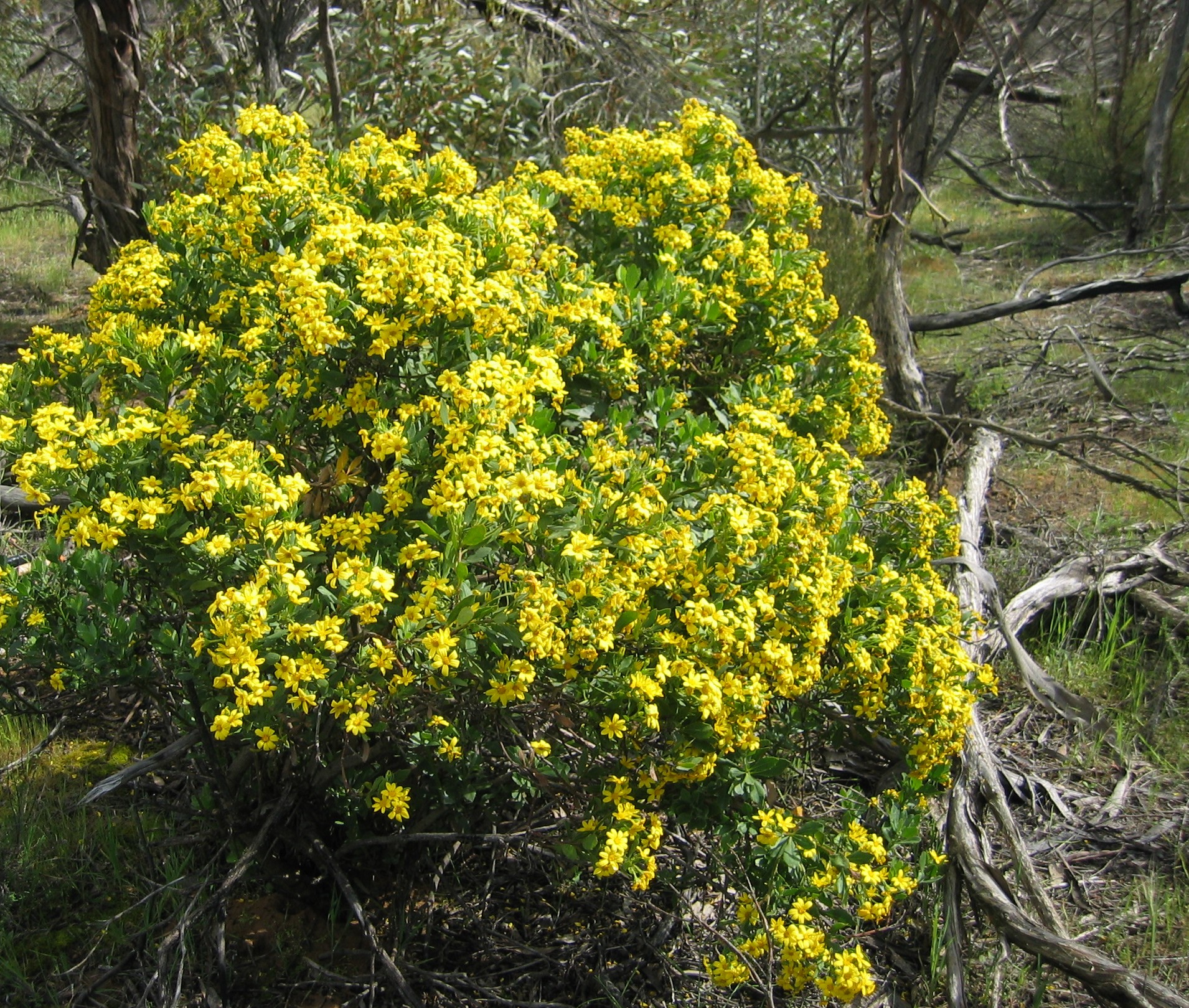
Photo: N Zeoli
Shrubs:
- large perennial evergreen shrub up to 3 metres high
- very hardy and adaptable with vigorous growth, and can out-compete native vegetation
- can live for 10 to 20 years and seedlings may continue to emerge from the seedbank for up to 15 years
Stems:
- Densely branched and upright/erect woody stems
- Old trunks can be up to 20 cm in diameter.
Leaves:
- Paddle or oval-shaped, about 5-7 cm long, 2-3 cm wide, and smooth except for a tuft of downy hair at the end.
- Dull green, smooth, irregularly serrated and paddle-shaped leaves arranged alternately on the branches.
- Young leaves are rounder and covered with white downy hair underneath which shed as they mature.
- Formed on short leaf stalks (petioles).
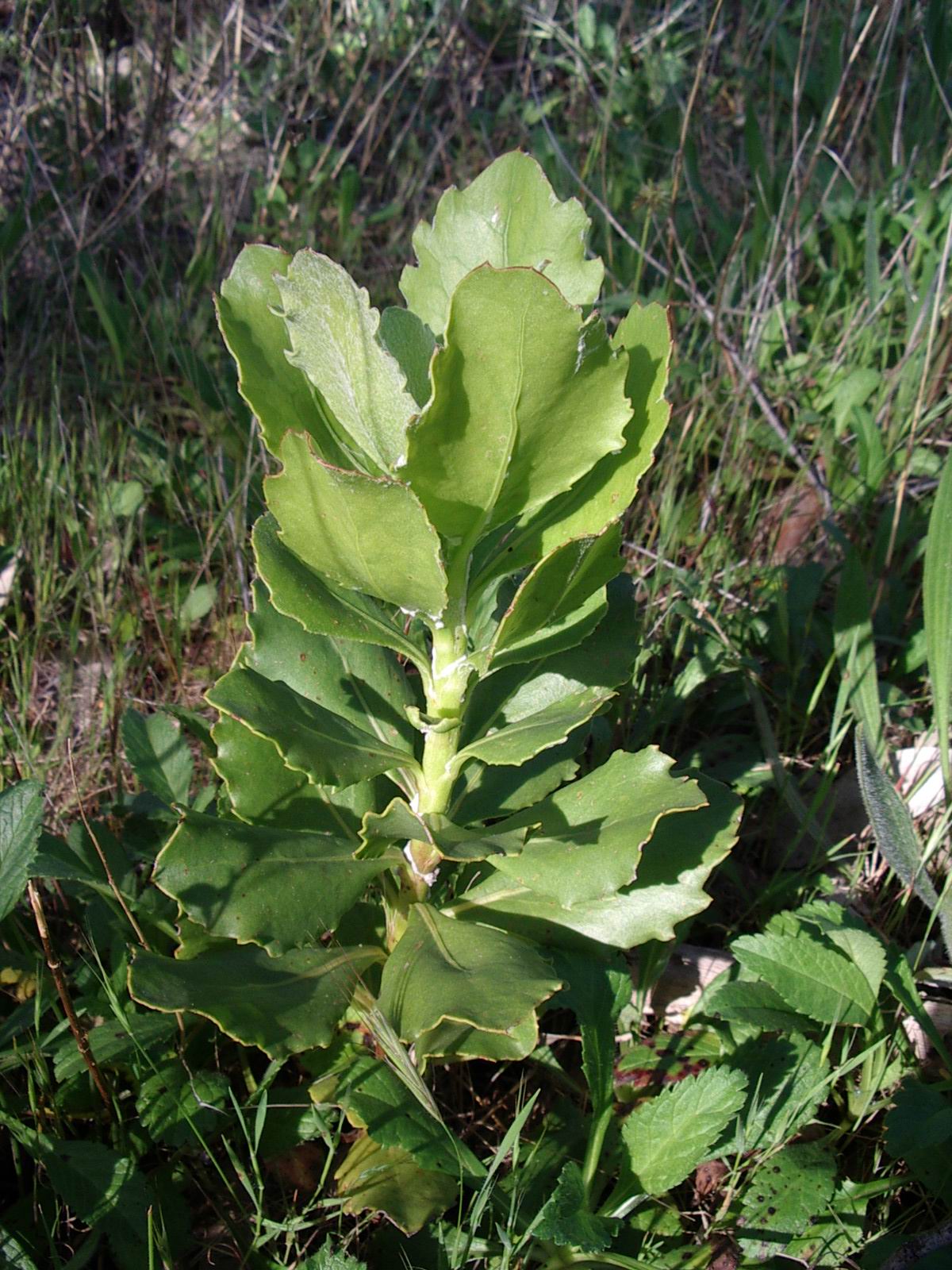
Photo: Peter Watton Trees4Life
Flowers:
- Typical daisy flowers, bright yellow with 4 to 8 yellow large ray florets (petals) surrounding smaller disc florets (centre).
- Up to 3 cm in diameter and forms in clusters at the end of branch tips.
- Flowering from August to October, but usually not until the plants are at least 18 months old and sometimes 3 years old.
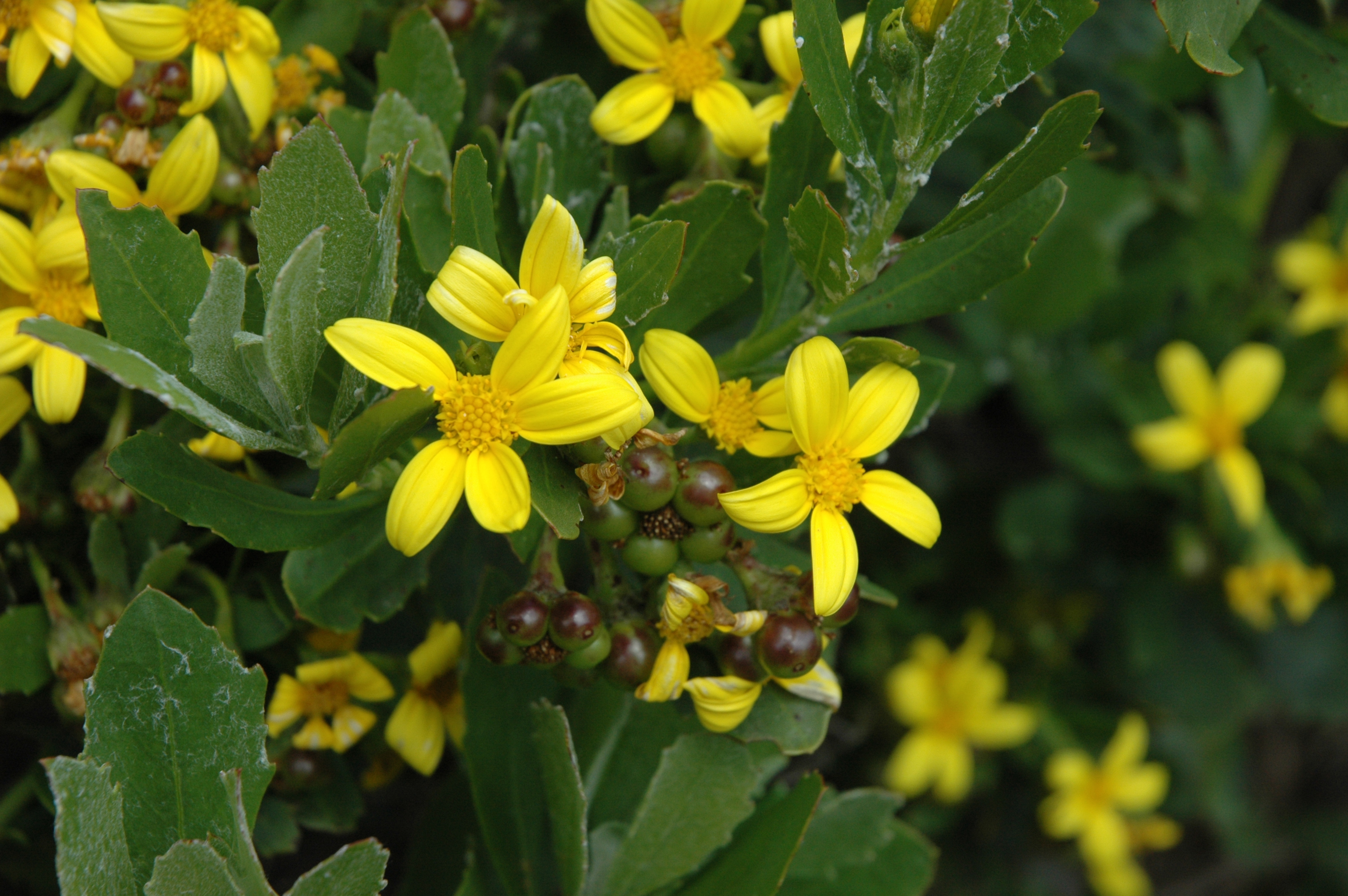
Fruit:
- Each flower head (inflorescence) produces clusters of up to 8 round, fleshy berries which ripen from green to black as they ripen.
- Appear in September to November and shed in summer.
Seeds:
- Each mature fruit/berry contains one smooth, very-hard (bone-like) seed.
- Each adult plant can produce up to 50,000 seeds per plant every year, so are prolific seeders.
- Seeds survive up to 15 years requiring long-term monitoring for new seedlings
- Germinate mainly in autumn but also any time of year if the soil is sufficiently moist.
- Birds are the main dispersal vector, but also animals and dumped garden waste.
- Seeds on ground either germinate or predated by rodents and ants.
- Viability of seeds is 60%.
- Seedbank is stimulated by fire, if not controlled can outcompete native plants post-fire.
Seedlings:
- Leaves with toothed edges, and new leaves with downy tufts.
- Up to 200 mm high.
- Easy to pull out by hand and can be found singly or in clusters.
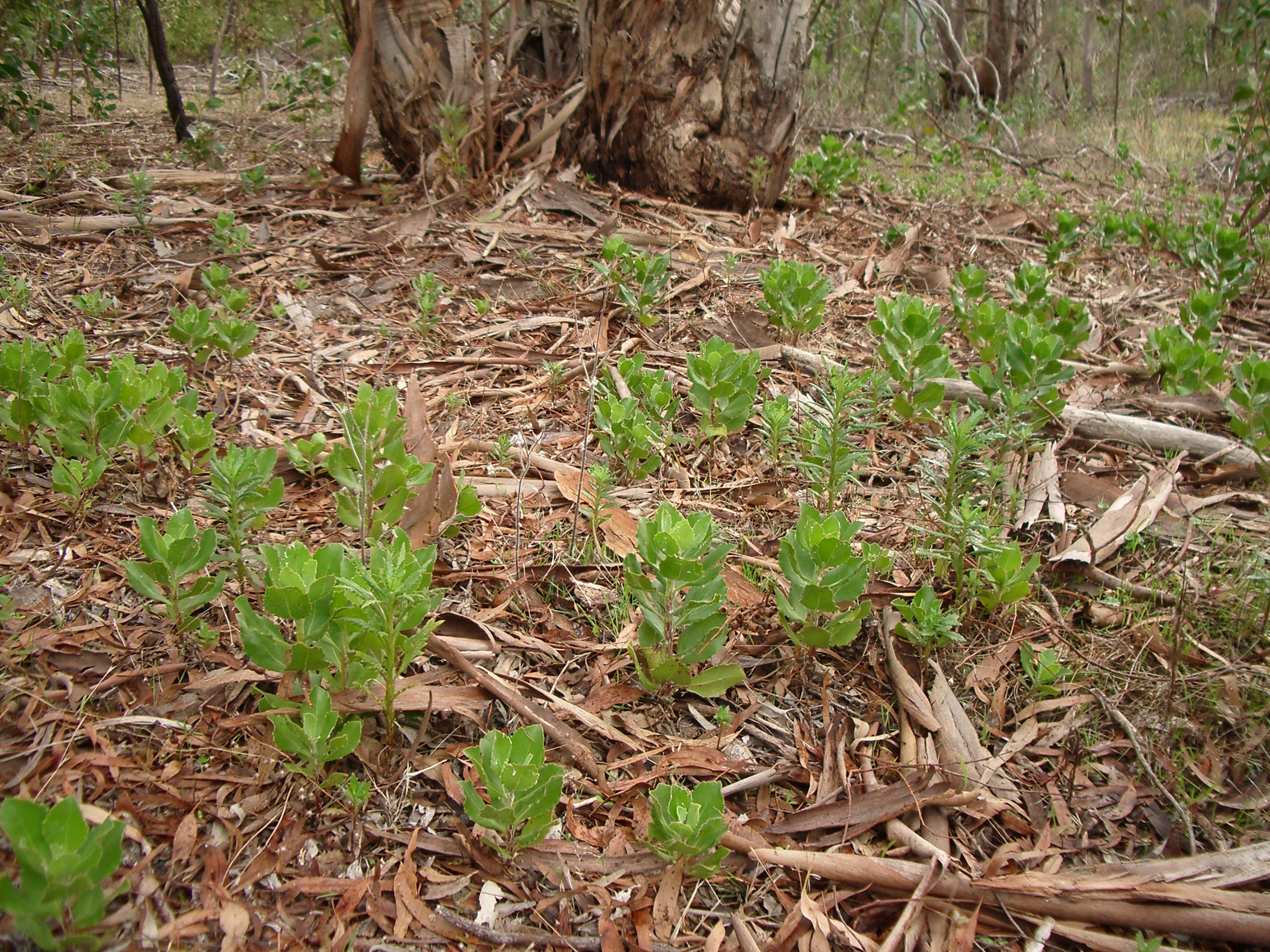
Roots:
- Shallow but extensively rooted, therefore reasonably easy to pull out.
Manual removal
If boneseed is found, hand-pull and up-end plants as they are shallow rooted and easily removed. To minimise soil disturbance, stand with feet either side of main stem. Larger, mature plants may need additional digging up or cutting down.
Leave weeded plants to die where they were found − don’t spread them to new places.
If the plants are fruiting or seeding, it is best to hand remove all fruits and flowers and bag – check for any fallen seed on seed on the ground, and arrange to safely burn or deep-bury onsite.
Larger fruiting plants are best disposed by bagging the entire plant then burning to prevent future germination. Movement is prohibited to prevent further dispersal of seed.
Chemical control
When using any agricultural chemicals please follow instructions on the label and any permit. Users of agricultural chemical products must always strictly comply with the directions on the label and the conditions of any permit. To view permits or product labels go to the Australian Pesticides and Veterinary Medicines Authority (APVMA) website.
Recommended herbicides:
• Picloram
• Metsulfuron
• Glyphosate
• Trounce®
|
Herbicide: Picloram + triclopyr (Group 4) Various trade names see APVMA |
Details |
| Active ingredient | 100 g/L picloram + 300 g/L triclopyr |
| Rate of dilution for spot spraying | 1:200 |
| Time of application | Actively growing, vegetative, flowering and/or fruiting. Winter or spring preferred. |
| Remarks and other control methods | High volume: thorough coverage essential. Add 250 mL organo-silicone adjuvant per 100 L spray solution (e.g. Pulse®) |
|
Herbicide: Melsulfuron (Group 2) Various trade names see APVMA |
Details |
| Active ingredient | 600 g/kg Metsulfuron methyl |
| Rate of dilution for spot spraying | 1 g: 10 L |
| Rate of product/ 10 L water | 1 g |
| Wetting agent | Add 250 mL organo-silicone adjuvant per 100 L spray solution (e.g. Pulse®) |
| Time of application | When bushes are actively growing |
| Remarks and other control methods |
|
|
Herbicide: Glyphosate (Group M) Various trade names see APVMA |
Details |
| Active ingredient |
Other concentrations of glyphosate available. |
| Rate of product/ha | Not recommended |
| Rate of product/ 10 L water |
Adjust rates for other concentrations of glyphosate. |
| Wetting agent dilution | Add 250 mL organo-silicone adjuvant per 100 L spray solution (e.g. Pulse) |
| Time of application | Actively growing. Best results achieved at peak flowering. |
| Remarks and other control methods |
|
-
Boneseed factsheetpdf (2.13 MB)